Condo Visitor Parking in Singapore: Rules, Abuse and How LPR Fixes It
10
October
2026
MERCHANT
Promote your best aircon services on our platform where residents can avail through myCondo.
RESIDENT
Experience better condominium living and facilitate transactions for all your condo-related needs, including buying and selling products and services.
CONDO MANAGEMENT
Condo Managers get intuitive online-based system with exciting new features in administering units.

SHARE
How do condos stop visitor parking abuse? By making every visitor car traceable to a host unit and a time window. When a resident pre-registers a guest’s plate in an app and a licence plate recognition (LPR) camera reads it at the barrier, the system knows who invited the car, when it arrived and how long it has stayed. Guards stop arguing over paper slips, and the managing agent gets facts instead of complaints.
This guide covers the visitor parking problems Singapore condos face most often, the rules councils commonly adopt, and how LPR and a visitor management system (VMS) make those rules enforceable.
Most condos have far fewer visitor lots than units. A 500-unit estate might have a few dozen. That small pool is easily absorbed by a handful of habits.
Common visitor parking problems in condos
| Problem | Typical cause | Effect |
|---|---|---|
| Residents’ extra cars in visitor lots | Unit has more cars than its allocated decals | Real visitors cannot park |
| Long overnight stays | Guests or family staying for days | Lots blocked over weekends |
| Outsiders parking for nearby amenities | Condo is near an MRT station, mall or school | Security risk and lost lots |
| Lost or swapped paper passes | Dashboard slips, handwritten entries | No reliable record |
| Queues at the barrier | Guard writes plate and calls unit for each car | Cars back up onto the public road |
Rules should be simple, written into the estate’s by-laws through the proper process, and applied equally. Councils often consider:
The hard part is not writing the rules. It is enforcing them without a guard spending the whole shift walking the car park with a clipboard. That is where LPR comes in.
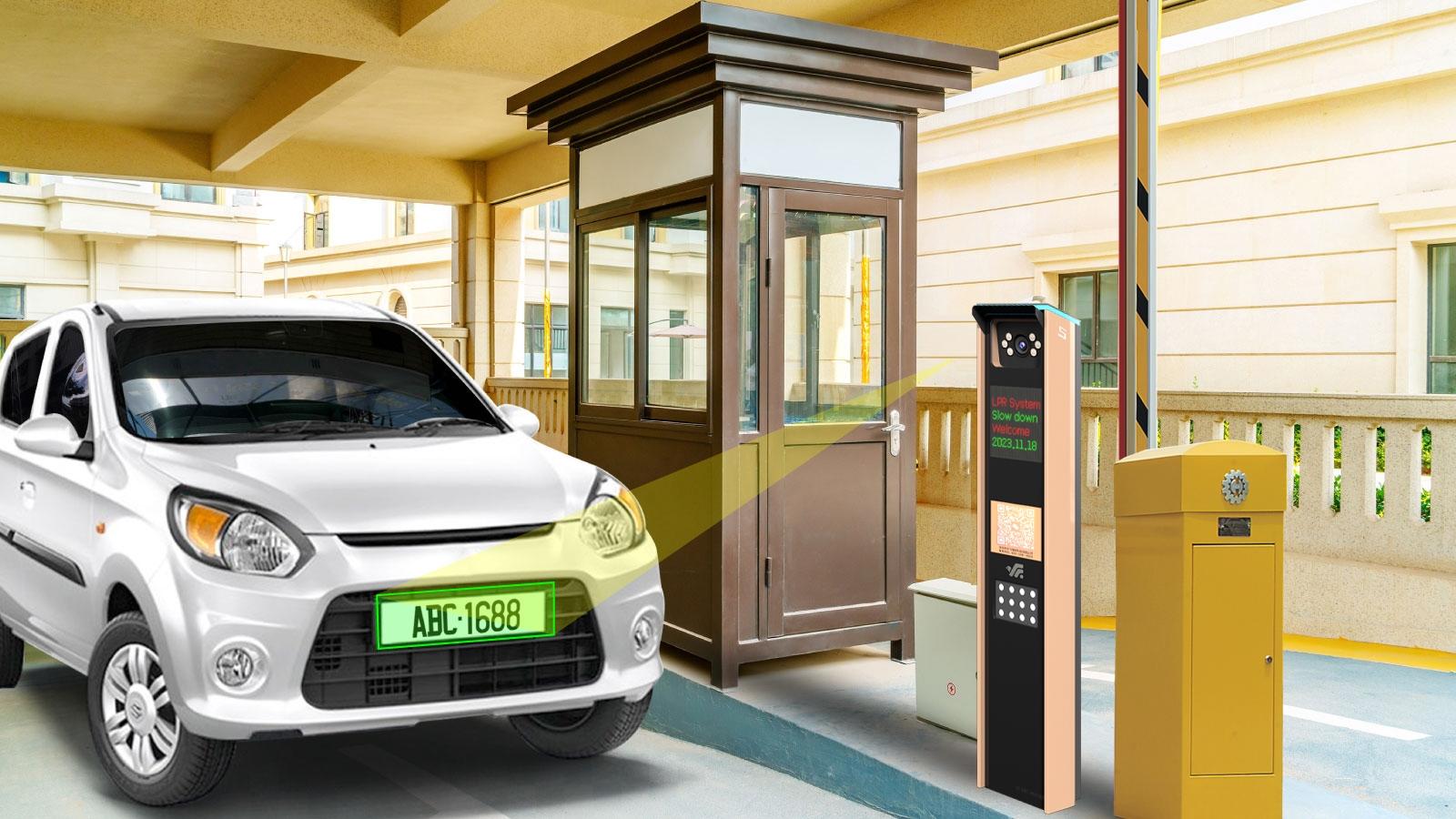
An LPR camera reads the plate of every vehicle approaching the barrier and checks it against lists held by the system.
On exit, a second camera or the same camera in the exit lane records departure time, so the system knows exactly how long each visitor stayed.
myCondo works with established camera brands. Two models we often recommend for condo barriers are below. A site survey decides the final choice, because lighting, angle and lane width matter as much as the camera.
LPR camera comparison for condo car parks
| Feature | Dahua ITC413-PW4D | Hikvision DeepinView iDS-2CD7A26G0/P-IZHS |
|---|---|---|
| Resolution | 4MP | 2MP |
| Allowlist and blocklist | Up to 110,000 each | Up to 10,000 records |
| Barrier control | Two relay outputs | Via alarm output or integration |
| Extra analytics | Recognition rate of 96% or higher for approaching and departing vehicles | Vehicle type, colour and brand; detects vehicles without plates; motorcycle plates in checkpoint scenarios |
| Housing rating | IP67, IK10 | IP67, IK10 |
| Best fit | Dedicated barrier lanes at estate entrances | Entrances where vehicle details beyond the plate are useful |
Cameras produce data. The value comes from what the managing agent does with it.
Treat plate data as personal data under the PDPA when it can be linked to a person. Keep visitor plate records only as long as needed for security and enforcement, restrict access to authorised staff, and tell residents and visitors how the data is used, for example through signage at the entrance and a short notice in the app.
Good parking technology should feel easier for residents, not stricter.
myCondo provides LPR cameras, barrier integration, the resident app and the guard console as one system, with after-sales support from our Singapore team. We integrate cameras from Dahua Technology and Hikvision, access terminals from Akuvox and video management from Milestone, so vehicle, pedestrian and CCTV records sit in one place.
Modern LPR cameras read Singapore plates well when they are installed at the right angle and height with suitable lighting. A site survey and proper tuning matter more than the brand.
The barrier stays closed and the guard sees the car on screen. The guard follows the normal walk-in process and can open the barrier manually. The event is still logged.
It can be, when it can be linked to an identifiable person. Treat it with PDPA safeguards: collect it for a clear purpose, restrict access and delete it when no longer needed.
Some cameras support motorcycle plates in checkpoint scenarios, but results depend on the lane layout. Confirm during the site survey.
Guards still handle exceptions, walk-in visitors and incidents. LPR removes the routine work so they can focus on those.
Want fewer parking complaints and shorter barrier queues? We can survey your car park entrances and recommend a setup.
WhatsApp or call: +65 8812 3888
Email: [email protected]
Visit: 8 Ubi Road 2, #07-13 Zervex, Singapore 408538
YOU MIGHT ALSO LIKE
Why integrate visitor management with CCTV? Because most condo investigations start with a question like "who came into Block 3 between 2pm and 4pm on Saturday?" If the visitor log and the CCTV recorder are separate, a guard has to read the log, note times, then scrub...
What is a recurring visitor pass? It is a visitor registration that repeats on a schedule, for example every Tuesday and Thursday from 3pm to 6pm. The resident sets it up once in the condo app, the visitor receives a QR code or mobile pass, and the gate lets them in...
Are short-term rentals allowed in Singapore condos? No, not without approval. The Urban Redevelopment Authority (URA) sets a minimum stay of three consecutive months for private residential properties, including condominiums. Renting a unit out for days or weeks...
NEVER MISS OUR ARTICLES
Get our stories delivered from us to you.